taylor#
- scipy.signal.windows.taylor(M, nbar=4, sll=30, norm=True, sym=True, *, xp=None, device=None)[source]#
Return a Taylor window.
The Taylor window taper function approximates the Dolph-Chebyshev window’s constant sidelobe level for a parameterized number of near-in sidelobes, but then allows a taper beyond [2].
The SAR (synthetic aperture radar) community commonly uses Taylor weighting for image formation processing because it provides strong, selectable sidelobe suppression with minimum broadening of the mainlobe [1].
- Parameters:
- Mint
Number of points in the output window. If zero, an empty array is returned. An exception is thrown when it is negative.
- nbarint, optional
Number of nearly constant level sidelobes adjacent to the mainlobe.
- sllfloat, optional
Desired suppression of sidelobe level in decibels (dB) relative to the DC gain of the mainlobe. This should be a positive number.
- normbool, optional
When True (default), divides the window by the largest (middle) value for odd-length windows or the value that would occur between the two repeated middle values for even-length windows such that all values are less than or equal to 1. When False the DC gain will remain at 1 (0 dB) and the sidelobes will be sll dB down.
- symbool, optional
When True (default), generates a symmetric window, for use in filter design. When False, generates a periodic window, for use in spectral analysis.
- xparray_namespace, optional
Optional array namespace. Should be compatible with the array API standard, or supported by array-api-compat. Default:
numpy- deviceany
optional device specification for output. Should match one of the supported device specification in
xp.
- Returns:
- outarray
The window. When norm is True (default), the maximum value is normalized to 1 (though the value 1 does not appear if M is even and sym is True).
Notes
Array API Standard Support
taylorhas support for Python Array API Standard compatible backends in addition to NumPy. The following combinations of backend and device (or other capability) are supported.Library
CPU
GPU
NumPy
✅
n/a
CuPy
n/a
✅
PyTorch
✅
✅
JAX
✅
✅
Dask
✅
n/a
See Support for the array API standard for more information.
References
[1]W. Carrara, R. Goodman, and R. Majewski, “Spotlight Synthetic Aperture Radar: Signal Processing Algorithms” Pages 512-513, July 1995.
[2]Armin Doerry, “Catalog of Window Taper Functions for Sidelobe Control”, 2017. https://www.researchgate.net/profile/Armin_Doerry/publication/316281181_Catalog_of_Window_Taper_Functions_for_Sidelobe_Control/links/58f92cb2a6fdccb121c9d54d/Catalog-of-Window-Taper-Functions-for-Sidelobe-Control.pdf
Examples
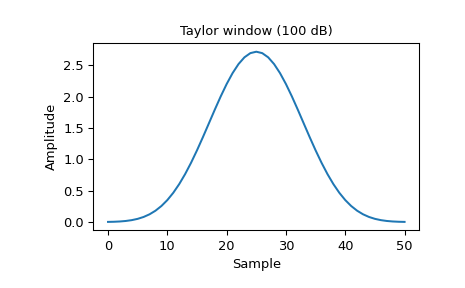
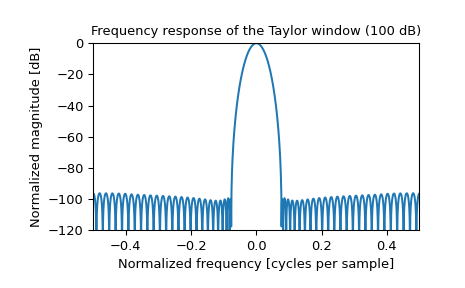
Plot the window and its frequency response:
>>> import numpy as np
>>> from scipy import signal
>>> from scipy.fft import fft, fftshift
>>> import matplotlib.pyplot as plt
>>> window = signal.windows.taylor(51, nbar=20, sll=100, norm=False)
>>> plt.plot(window)
>>> plt.title("Taylor window (100 dB)")
>>> plt.ylabel("Amplitude")
>>> plt.xlabel("Sample")
>>> plt.figure()
>>> A = fft(window, 2048) / (len(window)/2.0)
>>> freq = np.linspace(-0.5, 0.5, len(A))
>>> response = 20 * np.log10(np.abs(fftshift(A / abs(A).max())))
>>> plt.plot(freq, response)
>>> plt.axis([-0.5, 0.5, -120, 0])
>>> plt.title("Frequency response of the Taylor window (100 dB)")
>>> plt.ylabel("Normalized magnitude [dB]")
>>> plt.xlabel("Normalized frequency [cycles per sample]")