
scipy.special.ellipj#
- scipy.special.ellipj(u, m, out=None) = <ufunc 'ellipj'>#
Jacobi elliptic functions.
Calculates the Jacobi elliptic functions of parameter m less than or equal to 1, and real argument u.
- Parameters:
- uarray_like
Argument.
- marray_like
Parameter.
- outtuple of ndarray, optional
Optional output arrays for the function values
- Returns:
- sn, cn, dn, ph4-tuple of scalar or ndarray
The returned functions:
sn(u|m), cn(u|m), dn(u|m)
The value ph is such that if
u = ellipkinc(ph, m), thensn(u|m) = sin(ph)andcn(u|m) = cos(ph).
See also
Notes
Wrapper for the Cephes [1] routine
ellpj.These functions are periodic, with quarter-period on the real axis equal to the complete elliptic integral
ellipk(m).Relation to incomplete elliptic integral: If
u = ellipkinc(phi,m), thensn(u|m) = sin(phi), andcn(u|m) = cos(phi). Thephiis called the amplitude of u.Computation is by means of the arithmetic-geometric mean algorithm, except when m is within 1e-9 of 0 or 1. In the latter case with m close to 1, the approximation applies only for
phi < pi/2.References
[1]Cephes Mathematical Functions Library, http://www.netlib.org/cephes/
Examples
The elliptic sine sn(u|m) interpolates between the sine function and the hyperbolic tangent when m changes from 0 to 1.
>>> import matplotlib.pyplot as plt
>>> import numpy as np
>>> from scipy.special import ellipj
>>> u = np.linspace(0, 2*np.pi, 100)
>>> fig, ax = plt.subplots()
>>> ax.plot(u, np.sin(u), '--', label='sin(u)')
>>> for m in (0.2, 0.8, 0.99):
...     ax.plot(u, ellipj(u, m)[0], label=f'sn(u|{m})')
>>> ax.plot(u, np.tanh(u), '--', label='tanh(u)')
>>> ax.set_xlabel('u')
>>> ax.legend(loc='lower left')
>>> plt.show()
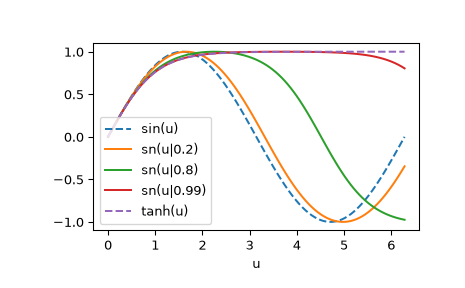
Like for sine and cosine, the squares of elliptic sine and elliptic cosine add up to one.
>>> u = np.linspace(0, 5, 11)
>>> sn, cn, _, _ = ellipj(u, 0.7)
>>> sn**2 + cn**2
array([1., 1., 1., 1., 1., 1., 1., 1., 1., 1., 1.])