scipy.special.i1#
- scipy.special.i1(x, out=None) = <ufunc 'i1'>#
Modified Bessel function of order 1.
Defined as,
\[I_1(x) = \frac{1}{2}x \sum_{k=0}^\infty \frac{(x^2/4)^k}{k! (k + 1)!} = -\imath J_1(\imath x),\]where \(J_1\) is the Bessel function of the first kind of order 1.
- Parameters:
- xarray_like
Argument (float)
- outndarray, optional
Optional output array for the function values
- Returns:
- Iscalar or ndarray
Value of the modified Bessel function of order 1 at x.
See also
Notes
The range is partitioned into the two intervals [0, 8] and (8, infinity). Chebyshev polynomial expansions are employed in each interval.
This function is a wrapper for the Cephes [1] routine
i1.Array API Standard Support
i1has support for Python Array API Standard compatible backends in addition to NumPy. The following combinations of backend and device (or other capability) are supported.Library
CPU
GPU
NumPy
✅
n/a
CuPy
n/a
✅
PyTorch
✅
✅
JAX
✅
✅
Dask
✅
n/a
For the NumPy backend, this function supports all NumPy ufunc keyword arguments. Other backends may support
out, but typically none of the other ufunc kwargs.outis typically supported for CuPy and PyTorch, but not currently in cases where SciPy relies on a generic Array API implementation or, for PyTorch on CPU, falls back to the NumPy backend.outis never supported for JAX because JAX arrays are immutable.See Support for the array API standard for more information.
References
[1]Cephes Mathematical Functions Library, http://www.netlib.org/cephes/
Examples
Calculate the function at one point:
>>> from scipy.special import i1
>>> i1(1.)
0.5651591039924851
Calculate the function at several points:
>>> import numpy as np
>>> i1(np.array([-2., 0., 6.]))
array([-1.59063685,  0.        , 61.34193678])
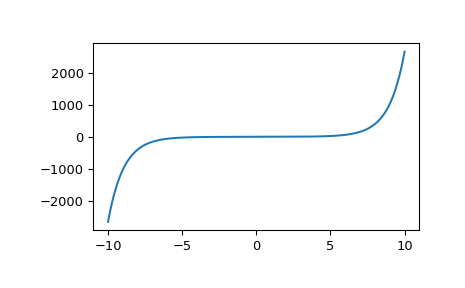
Plot the function between -10 and 10.
>>> import matplotlib.pyplot as plt
>>> fig, ax = plt.subplots()
>>> x = np.linspace(-10., 10., 1000)
>>> y = i1(x)
>>> ax.plot(x, y)
>>> plt.show()