scipy.special.fresnel#
- scipy.special.fresnel(z, out=None) = <ufunc 'fresnel'>#
Fresnel integrals.
The Fresnel integrals are defined as
\[\begin{split}S(z) &= \int_0^z \sin(\pi t^2 /2) dt, \\ C(z) &= \int_0^z \cos(\pi t^2 /2) dt.\end{split}\]See [dlmf] for details.
- Parameters:
- zarray_like
Real or complex valued argument
- out2-tuple of ndarrays, optional
Optional output arrays for the function results
- Returns:
- S, C2-tuple of scalar or ndarray
Values of the Fresnel integrals
See also
fresnel_zeroszeros of the Fresnel integrals
References
[dlmf]NIST Digital Library of Mathematical Functions https://dlmf.nist.gov/7.2#iii
Examples
>>> import numpy as np
>>> from scipy.special import fresnel, erf
First, we verify the following limits:
\[\lim_{z \to \infty} S(z) = \lim_{z \to \infty} C(z) = 1/2.\]>>> S, C = fresnel([0.1, 1, 10, 100, np.inf]) >>> S array([0.00052359, 0.43825915, 0.46816998, 0.4968169 , 0.5 ]) >>> C array([0.09999753, 0.7798934 , 0.49989869, 0.4999999 , 0.5 ])
Next, we verify the following relation to the error function:
\[C(z) + i S(z) = \frac{1 + i}{2} \operatorname{erf}\left(\frac{\sqrt{\pi}(1 - i)}{2} z\right).\]>>> z = np.linspace(-10, 10) >>> S, C = fresnel(z) >>> RHS = (1 + 1j)/2 * erf((np.sqrt(np.pi)*(1 - 1j))/2*z) >>> np.allclose(C + 1j*S, RHS) True
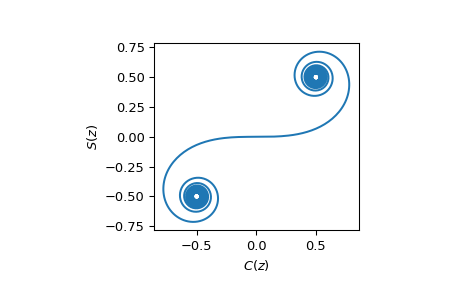
Finally, we plot \(C(z)\) against \(S(z)\) to get the Euler or Cornu spiral.
>>> import matplotlib.pyplot as plt
>>> z = np.linspace(-10, 10, num=1000)
>>> S, C = fresnel(z)
>>> fig, ax = plt.subplots()
>>> ax.plot(C, S)
>>> ax.set_aspect('equal')
>>> ax.set_xlabel('$C(z)$')
>>> ax.set_ylabel('$S(z)$')
>>> plt.show()