
scipy.special.eval_chebys#
- scipy.special.eval_chebys(n, x, out=None) = <ufunc 'eval_chebys'>#
Evaluate Chebyshev polynomial of the second kind on [-2, 2] at a point.
These polynomials are defined as
\[S_n(x) = U_n(x/2)\]where \(U_n\) is a Chebyshev polynomial of the second kind. See 22.5.13 in [AS] (or equivalently [DLMF]) for details.
- Parameters:
- narray_like
Degree of the polynomial. If not an integer, the result is determined via the relation to
eval_chebyu.- xarray_like
Points at which to evaluate the Chebyshev polynomial
- outndarray, optional
Optional output array for the function values
- Returns:
- Sscalar or ndarray
Values of the Chebyshev polynomial
See also
roots_chebysroots and quadrature weights of Chebyshev polynomials of the second kind on [-2, 2]
chebysChebyshev polynomial object
eval_chebyuevaluate Chebyshev polynomials of the second kind
References
[AS]Milton Abramowitz and Irene A. Stegun, eds. Handbook of Mathematical Functions with Formulas, Graphs, and Mathematical Tables. New York: Dover, 1972.
[DLMF]NIST Digital Library of Mathematical Functions, https://dlmf.nist.gov/18.1.E3
Examples
>>> import numpy as np
>>> from scipy.special import eval_chebys, eval_chebyu
>>> import matplotlib.pyplot as plt
Evaluate the order 3 polynomial at a few values of x.
>>> eval_chebys(3, [0, 0.25, 0.5])
array([-0.      , -0.484375, -0.875   ])
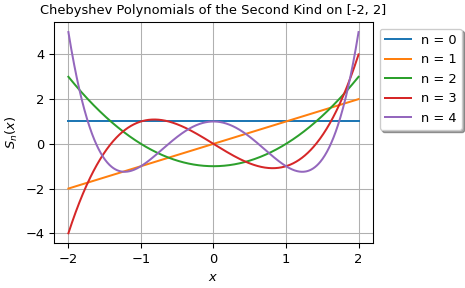
Plot the polynomials of order 0 through 4.
>>> x = np.linspace(-2, 2, 800)
>>> fig, ax = plt.subplots(1, 1, constrained_layout=True)
>>> for n in range(5):
...     y = eval_chebys(n, x)
...     ax.plot(x, y, label=f'{n = }')
>>> ax.grid()
>>> ax.set_title("Chebyshev Polynomials of the Second Kind on [-2, 2]")
>>> ax.set_xlabel("$x$")
>>> ax.set_ylabel("$S_n(x)$")
>>> ax.legend(loc='upper left', bbox_to_anchor=(1, 1), shadow=True)
>>> plt.show()
They are a scaled version of the Chebyshev polynomials of the second kind.
>>> x = np.linspace(-2, 2, 6)
>>> eval_chebys(3, x)
array([-4.   ,  0.672,  0.736, -0.736, -0.672,  4.   ])
>>> eval_chebyu(3, x / 2)
array([-4.   ,  0.672,  0.736, -0.736, -0.672,  4.   ])