scipy.special.erfcinv#
- scipy.special.erfcinv(y, out=None) = <ufunc 'erfcinv'>#
Inverse of the complementary error function.
Computes the inverse of the complementary error function.
In the complex domain, there is no unique complex number \(w\) satisfying \(\\operatorname{erfc}(w) = z\). This indicates a true inverse function would be multivalued. When the domain restricts to the real interval \(0 < x < 2\), there is a unique real number satisfying
\[\begin{split}\\operatorname{erfc}(\\operatorname{erfcinv}(x)) = x\end{split}\]It is related to the inverse of the error function by
\[\begin{split}\\operatorname{erfcinv}(1 - x) = \\operatorname{erfinv}(x)\end{split}\]- Parameters:
- yndarray
Argument at which to evaluate. Domain: \([0, 2]\)
- outndarray, optional
Optional output array for the function values
- Returns:
- erfcinvscalar or ndarray
The inverse of \(\\operatorname{erfc}\) of \(y\), element-wise
Examples
>>> import numpy as np
>>> import matplotlib.pyplot as plt
>>> from scipy.special import erfcinv
>>> erfcinv(0.5)
0.4769362762044699
>>> y = np.linspace(0.0, 2.0, num=11)
>>> erfcinv(y)
array([        inf,  0.9061938 ,  0.59511608,  0.37080716,  0.17914345,
       -0.        , -0.17914345, -0.37080716, -0.59511608, -0.9061938 ,
              -inf])
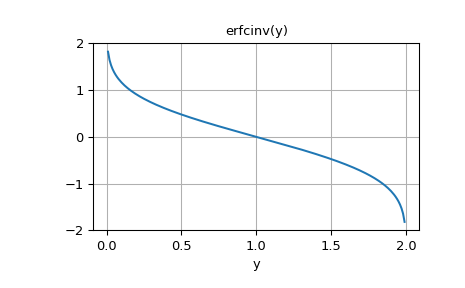
Plot the function:
>>> y = np.linspace(0, 2, 200)
>>> fig, ax = plt.subplots()
>>> ax.plot(y, erfcinv(y))
>>> ax.grid(True)
>>> ax.set_xlabel('y')
>>> ax.set_title('erfcinv(y)')
>>> plt.show()