
scipy.special.airye#
- scipy.special.airye(z, out=None) = <wrapped_ufunc 'airye'>#
Exponentially scaled Airy functions and their derivatives.
Scaling:
eAi  = Ai  * exp(2.0/3.0*z*sqrt(z))
eAip = Aip * exp(2.0/3.0*z*sqrt(z))
eBi  = Bi  * exp(-abs(2.0/3.0*(z*sqrt(z)).real))
eBip = Bip * exp(-abs(2.0/3.0*(z*sqrt(z)).real))
- Parameters:
- zarray_like
Real or complex argument.
- outtuple of ndarray, optional
Optional output arrays for the function values
- Returns:
- eAi, eAip, eBi, eBip4-tuple of scalar or ndarray
Exponentially scaled Airy functions eAi and eBi, and their derivatives eAip and eBip
See also
Notes
Wrapper for the AMOS [1] routines zairy and zbiry.
Array API Standard Support
airyehas support for Python Array API Standard compatible backends in addition to NumPy. The following combinations of backend and device (or other capability) are supported.Library
CPU
GPU
NumPy
✅
n/a
CuPy
n/a
⛔
PyTorch
✅
⛔
JAX
✅
⛔
Dask
⛔
n/a
For the NumPy backend, this function supports all NumPy ufunc keyword arguments. Other backends may support
out, but typically none of the other ufunc kwargs.outis typically supported for CuPy and PyTorch, but not currently in cases where SciPy relies on a generic Array API implementation or, for PyTorch on CPU, falls back to the NumPy backend.outis never supported for JAX because JAX arrays are immutable.airyedoes not currently supportoutfor the PyTorch backend.See Support for the array API standard for more information.
References
[1]Donald E. Amos, “AMOS, A Portable Package for Bessel Functions of a Complex Argument and Nonnegative Order”, http://netlib.org/amos/
Examples
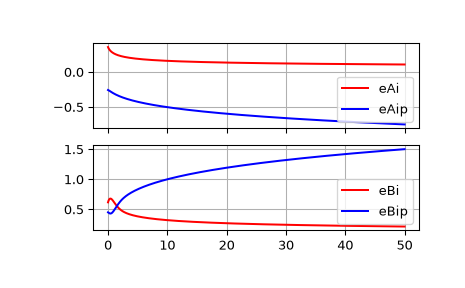
We can compute exponentially scaled Airy functions and their derivatives:
>>> import numpy as np
>>> from scipy.special import airye
>>> import matplotlib.pyplot as plt
>>> z = np.linspace(0, 50, 500)
>>> eAi, eAip, eBi, eBip = airye(z)
>>> f, ax = plt.subplots(2, 1, sharex=True)
>>> for ind, data in enumerate([[eAi, eAip, ["eAi", "eAip"]],
...                             [eBi, eBip, ["eBi", "eBip"]]]):
...     ax[ind].plot(z, data[0], "-r", z, data[1], "-b")
...     ax[ind].legend(data[2])
...     ax[ind].grid(True)
>>> plt.show()
We can compute these using usual non-scaled Airy functions by:
>>> from scipy.special import airy
>>> Ai, Aip, Bi, Bip = airy(z)
>>> np.allclose(eAi, Ai * np.exp(2.0 / 3.0 * z * np.sqrt(z)))
True
>>> np.allclose(eAip, Aip * np.exp(2.0 / 3.0 * z * np.sqrt(z)))
True
>>> np.allclose(eBi, Bi * np.exp(-abs(np.real(2.0 / 3.0 * z * np.sqrt(z)))))
True
>>> np.allclose(eBip, Bip * np.exp(-abs(np.real(2.0 / 3.0 * z * np.sqrt(z)))))
True
Comparing non-scaled and exponentially scaled ones, the usual non-scaled function quickly underflows for large values, whereas the exponentially scaled function does not.
>>> airy(200)
(0.0, 0.0, nan, nan)
>>> airye(200)
(0.07501041684381093, -1.0609012305109042, 0.15003188417418148, 2.1215836725571093)