wiener#
- scipy.signal.wiener(im, mysize=None, noise=None)[source]#
Perform a Wiener filter on an N-dimensional array.
Apply a Wiener filter to the N-dimensional array im.
- Parameters:
- imndarray
An N-dimensional array.
- mysizeint or array_like, optional
A scalar or an N-length list giving the size of the Wiener filter window in each dimension. Elements of mysize should be odd. If mysize is a scalar, then this scalar is used as the size in each dimension.
- noisefloat, optional
The noise-power to use. If None, then noise is estimated as the average of the local variance of the input.
- Returns:
- outndarray
Wiener filtered result with the same shape as im.
Notes
This implementation is similar to wiener2 in Matlab/Octave. For more details see [1]
Array API Standard Support
wienerhas support for Python Array API Standard compatible backends in addition to NumPy. The following combinations of backend and device (or other capability) are supported.Library
CPU
GPU
NumPy
✅
n/a
CuPy
n/a
✅
PyTorch
✅
⛔
JAX
⚠️ no JIT
⚠️ no JIT
Dask
⚠️ computes graph
n/a
See Support for the array API standard for more information.
References
[1]Lim, Jae S., Two-Dimensional Signal and Image Processing, Englewood Cliffs, NJ, Prentice Hall, 1990, p. 548.
Examples
>>> from scipy.datasets import face
>>> from scipy.signal import wiener
>>> import matplotlib.pyplot as plt
>>> import numpy as np
>>> rng = np.random.default_rng()
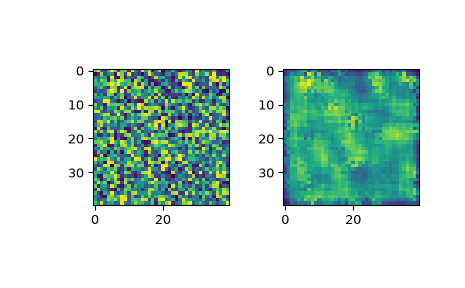
>>> img = rng.random((40, 40))    #Create a random image
>>> filtered_img = wiener(img, (5, 5))  #Filter the image
>>> f, (plot1, plot2) = plt.subplots(1, 2)
>>> plot1.imshow(img)
>>> plot2.imshow(filtered_img)
>>> plt.show()