bode#
- dlti.bode(w=None, n=100)[source]#
Calculate Bode magnitude and phase data of a discrete-time system.
- Parameters:
- warray_like, optional
Array of frequencies normalized to the Nyquist frequency being π, i.e., having unit radiant / sample. Magnitude and phase data is calculated for every value in this array. If not given, a reasonable set will be calculated.
- nint, optional
Number of frequency points to compute if w is not given. The n frequencies are logarithmically spaced in an interval chosen to include the influence of the poles and zeros of the system. Defaults to 100.
- Returns:
- w1D ndarray
Array of frequencies normalized to the Nyquist frequency being
np.pi/dtwithdtbeing the sampling interval of the system parameter. The unit is rad/s assumingdtis in seconds.- mag1D ndarray
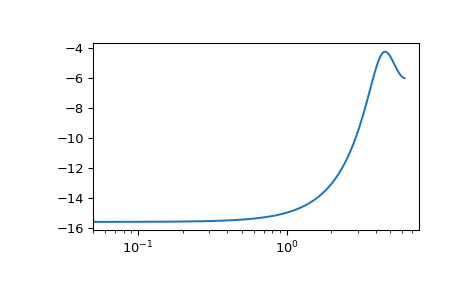
Magnitude array in dB
- phase1D ndarray
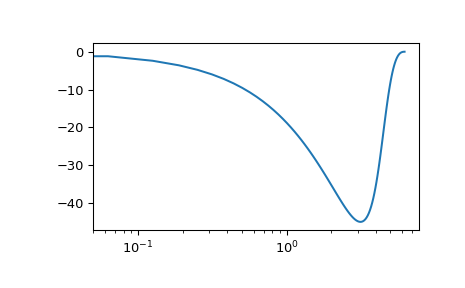
Phase array in degrees
See also
dbodeBode plot data for discrete-time LTI systems.
Examples
>>> from scipy import signal
>>> import matplotlib.pyplot as plt
Construct the transfer function \(H(z) = \frac{1}{z^2 + 2z + 3}\) with sampling time 0.5s:
>>> sys = signal.TransferFunction([1], [1, 2, 3], dt=0.5)
Equivalent: signal.dbode(sys)
>>> w, mag, phase = sys.bode()
>>> plt.figure()
>>> plt.semilogx(w, mag)    # Bode magnitude plot
>>> plt.figure()
>>> plt.semilogx(w, phase)  # Bode phase plot
>>> plt.show()