
Mixture#
- class scipy.stats.Mixture(components, *, weights=None)[source]#
Representation of a mixture distribution.
A mixture distribution is the distribution of a random variable defined in the following way: first, a random variable is selected from
componentsaccording to the probabilities given byweights, then the selected random variable is realized.- Parameters:
- componentssequence of UnivariateDistribution
The underlying instances of UnivariateDistribution. All must have scalar shape parameters (if any); e.g., the
meanmust return a scalar.- weightssequence of floats, optional
The corresponding probabilities of selecting each random variable. Must be non-negative and sum to one. The default behavior is to weight all components equally.
- Attributes:
- componentssequence of UnivariateDistribution
The underlying instances of UnivariateDistribution.
- weightsndarray
The corresponding probabilities of selecting each random variable.
Methods
support()Support of the random variable
sample([shape, rng, method])Random sample from the distribution.
moment([order, kind, method])Raw, central, or standard moment of positive integer order.
mean(*[, method])Mean, a measure of location
median(*[, method])Median, a measure of location
mode(*[, method])Mode, the most likely value
variance(*[, method])Variance, a measure of dispersion
standard_deviation(*[, method])Standard deviation, a measure of dispersion
skewness(*[, method])Skewness, a measure of asymmetry
kurtosis(*[, method])Kurtosis, a measure of tailedness
pdf(x, /, *[, method])Probability density function
logpdf(x, /, *[, method])Log of the probability density function
cdf(x[, y, method])Cumulative distribution function
icdf(p, /, *[, method])Inverse of the cumulative distribution function.
ccdf(x[, y, method])Complementary cumulative distribution function
iccdf(p, /, *[, method])Inverse complementary cumulative distribution function.
logcdf(x[, y, method])Log of the cumulative distribution function
ilogcdf(p, /, *[, method])Inverse of the logarithm of the cumulative distribution function.
logccdf(x[, y, method])Log of the complementary cumulative distribution function
ilogccdf(p, /, *[, method])Inverse of the log of the complementary cumulative distribution function.
entropy(*[, method])Differential entropy
Notes
Methods
median,mode,entropy,logentropy,icdf,iccdf,ilogcdf, andilogccdfare currently implemented only when all components are continuous distributions.The following abbreviations are used throughout the documentation.
PDF: probability density function
CDF: cumulative distribution function
CCDF: complementary CDF
entropy: differential entropy
log-F: logarithm of F (e.g. log-CDF)
inverse F: inverse function of F (e.g. inverse CDF)
References
[1]Mixture distribution, Wikipedia, https://en.wikipedia.org/wiki/Mixture_distribution
[2]Zero-inflated model, Wikipedia, https://en.wikipedia.org/wiki/Zero-inflated_model
Examples
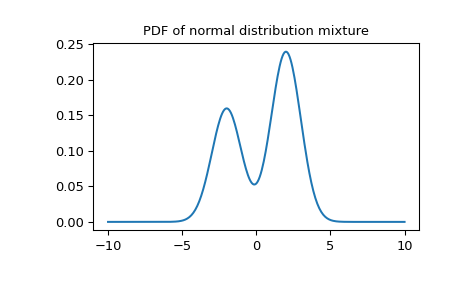
A mixture of normal distributions:
>>> import numpy as np
>>> from scipy import stats
>>> import matplotlib.pyplot as plt
>>> X1 = stats.Normal(mu=-2, sigma=1)
>>> X2 = stats.Normal(mu=2, sigma=1)
>>> mixture = stats.Mixture([X1, X2], weights=[0.4, 0.6])
>>> print(f'mean: {mixture.mean():.2f}, '
...       f'median: {mixture.median():.2f}, '
...       f'mode: {mixture.mode():.2f}')
mean: 0.40, median: 1.04, mode: 2.00
>>> x = np.linspace(-10, 10, 300)
>>> plt.plot(x, mixture.pdf(x))
>>> plt.title('PDF of normal distribution mixture')
>>> plt.show()
A zero-inflated Poisson model.
>>> Poisson = stats.make_distribution(stats.poisson)
>>> lmb = 10  # expected Poisson count
>>> pi = 0.4  # probability of extra zeros
>>> X = stats.Binomial(n=0, p=0)  # degenerate distribution; all zero
>>> Y = Poisson(mu=lmb)
>>> ZIP = stats.Mixture((X, Y), weights=(pi, 1-pi))
>>> true_mean = (1 - pi) * lmb  # see e.g. [2]
>>> print(np.allclose(ZIP.mean(), true_mean))
True
>>> true_variance = lmb*(1 - pi)*(1 + pi*lmb)  # see e.g. [2]
>>> print(np.allclose(ZIP.variance(), true_variance))
True