
scipy.special.mathieu_se#
- scipy.special.mathieu_se(m, q, x, out=None) = <wrapped_ufunc 'mathieu_se'>#
Odd Mathieu function and its derivative.
Returns the odd Mathieu function, \(\mathrm{se}_m(x, q)\), of order \(m\) and parameter \(q\) evaluated at \(x\) (given in radians). Also returns its derivative with respect to \(x\).
- Parameters:
- marray_like
Order of the function. Must be a non-negative integer.
- qarray_like
Parameter of the function.
- xarray_like
Argument of the function, given in radians.
- outtuple of ndarray, optional
Optional output arrays for the function results.
- Returns:
- yscalar or ndarray
Value of the function.
- ypscalar or ndarray
Derivative with respect to x (per radian).
See also
Notes
Odd Mathieu functions are the solutions to Mathieu’s differential equation
\[\frac{d^2y}{dx^2} + (b_m - 2q \cos(2x))y = 0\]for which the characteristic number \(b_m\) (calculated with
mathieu_b) results in an odd, periodic solution \(y(x)\) with period \(\pi\) (for even \(m\)) or \(2\pi\) (for odd \(m\)).For \(m = 0\), both outputs are zero.
Added in version 2.0.0.
Array API Standard Support
mathieu_sehas support for Python Array API Standard compatible backends in addition to NumPy. The following combinations of backend and device (or other capability) are supported.Library
CPU
GPU
NumPy
✅
n/a
CuPy
n/a
⛔
PyTorch
✅
⛔
JAX
✅
⛔
Dask
⛔
n/a
For the NumPy backend, this function supports all NumPy ufunc keyword arguments. Other backends may support
out, but typically none of the other ufunc kwargs.outis typically supported for CuPy and PyTorch, but not currently in cases where SciPy relies on a generic Array API implementation or, for PyTorch on CPU, falls back to the NumPy backend.outis never supported for JAX because JAX arrays are immutable.mathieu_sedoes not currently supportoutfor the PyTorch backend.See Support for the array API standard for more information.
References
[1]‘Mathieu function’. Wikipedia. https://en.wikipedia.org/wiki/Mathieu_function
[2]Stuart Brorson, A New Implementation of the Mathieu Functions for SciPy. brorson/ScipyMathieuPaper
Examples
Plot odd Mathieu functions of orders \(m = 2\) and \(m = 4\).
>>> import numpy as np
>>> from scipy import special
>>> import matplotlib.pyplot as plt
>>> m = np.asarray([2, 4])
>>> q = 50
>>> x = np.linspace(-np.pi, np.pi, 300)[:, np.newaxis]
>>> y, _ = special.mathieu_se(m, q, x)
>>> plt.plot(x, y)
>>> plt.xticks(
...     [-np.pi, -np.pi/2, 0, np.pi/2, np.pi],
...     [r"$-\pi$", r"$-\pi/2$", r"$0$", r"$\pi/2$", r"$\pi$"]
... )
>>> plt.xlabel('x (radians)')
>>> plt.ylabel('y')
>>> plt.legend(('m = 2', 'm = 4'))
>>> plt.show()
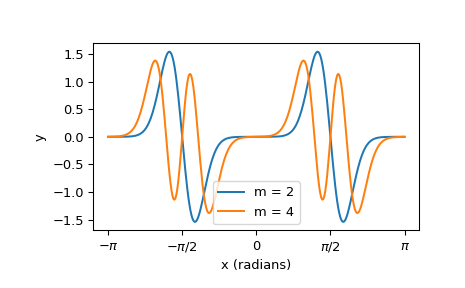
Because the orders \(2\) and \(4\) are even, the period of each function is \(\pi\).
Now plot the functions of odd orders \(m = 1\) and \(m = 3\).
>>> m = np.asarray([1, 3])
>>> y, _ = special.mathieu_se(m, q, x)
>>> plt.figure()
>>> plt.plot(x, y)
>>> plt.xticks(
...     [-np.pi, -np.pi/2, 0, np.pi/2, np.pi],
...     [r"$-\pi$", r"$-\pi/2$", r"$0$", r"$\pi/2$", r"$\pi$"]
... )
>>> plt.xlabel('x (radians)')
>>> plt.ylabel('y')
>>> plt.legend(('m = 1', 'm = 3'))
>>> plt.show()
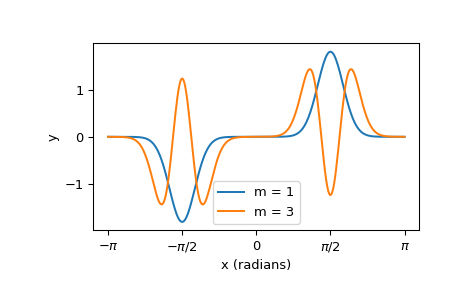
Because the orders \(1\) and \(3\) are odd, the period of each function is \(2\pi\).