scipy.special.
chebyc#
- scipy.special.chebyc(n, monic=False)[source]#
Chebyshev polynomial of the first kind on \([-2, 2]\).
Defined as \(C_n(x) = 2T_n(x/2)\), where \(T_n\) is the nth Chebyshev polynomial of the first kind.
- Parameters:
- nint
Degree of the polynomial.
- monicbool, optional
If True, scale the leading coefficient to be 1. Default is False.
- Returns:
- Corthopoly1d
Chebyshev polynomial of the first kind on \([-2, 2]\).
See also
chebytChebyshev polynomial of the first kind.
Notes
The polynomials \(C_n(x)\) are orthogonal over \([-2, 2]\) with weight function \(1/\sqrt{1 - (x/2)^2}\).
References
[1]Abramowitz and Stegun, “Handbook of Mathematical Functions” Section 22. National Bureau of Standards, 1972.
Examples
Evaluate the Chebyshev polynomial \(C_3\) at \(x = 1\):
>>> import numpy as np
>>> from scipy.special import chebyc, chebyt
>>> np.isclose(chebyc(3)(1), -2.0)
True
The polynomial \(C_n\) is a scaled Chebyshev polynomial of the first kind:
>>> x = np.linspace(-2, 2, 5)
>>> np.allclose(chebyc(3)(x), 2 * chebyt(3)(x/2))
True
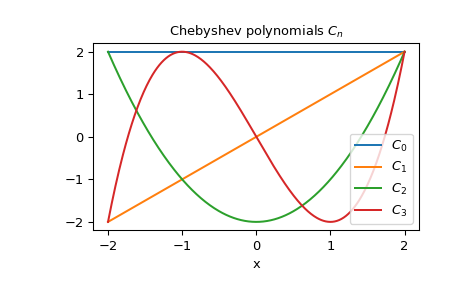
Plot \(C_n\) for several values of \(n\):
>>> import matplotlib.pyplot as plt
>>> x = np.linspace(-2, 2, 400)
>>> fig, ax = plt.subplots()
>>> for n in range(4):
...     ax.plot(x, chebyc(n)(x), label=rf"$C_{n}$")
>>> ax.set_title(r"Chebyshev polynomials $C_n$")
>>> ax.set_xlabel("x")
>>> ax.legend(loc="best")
>>> plt.show()