irfft2#
- scipy.fft.irfft2(x, s=None, axes=(-2, -1), norm=None, overwrite_x=False, workers=None, *, plan=None)[source]#
Computes the inverse of
rfft2.- Parameters:
- xarray_like
The input array
- ssequence of ints, optional
Shape of the real output to the inverse FFT.
- axessequence of ints, optional
The axes over which to compute the inverse fft. Default is the last two axes.
- norm{“backward”, “ortho”, “forward”}, optional
Normalization mode (see
fft). Default is “backward”.- overwrite_xbool, optional
If True, the contents of x can be destroyed; the default is False. See
fftfor more details.- workersint, optional
Maximum number of workers to use for parallel computation. If negative, the value wraps around from
os.cpu_count(). Seefftfor more details.- planobject, optional
This argument is reserved for passing in a precomputed plan provided by downstream FFT vendors. It is currently not used in SciPy.
Added in version 1.5.0.
- Returns:
- outndarray
The result of the inverse real 2-D FFT.
See also
Notes
This is really
irfftnwith different defaults. For more details seeirfftn.Array API Standard Support
irfft2has support for Python Array API Standard compatible backends in addition to NumPy. The following combinations of backend and device (or other capability) are supported.Library
CPU
GPU
NumPy
✅
n/a
CuPy
n/a
✅
PyTorch
✅
✅
JAX
✅
✅
Dask
⚠️ computes graph
n/a
See Support for the array API standard for more information.
Examples
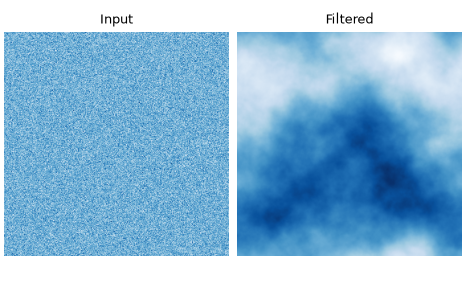
Here’s a simple FFT-based lowpass filter applied to an image of white noise.
This code will generate an image of white noise, use
rfft2to transform it to the frequency domain, apply a lowpass filter, and then transform back to the spatial domain withirfft2.>>> import numpy as np >>> import matplotlib.pyplot as plt >>> from scipy.fft import rfft2, irfft2, fftfreq, rfftfreq ... >>> rng = np.random.default_rng() >>> m = 280 # Image size is m x m.
Generate an image of white noise:
>>> im = rng.normal(size=(m, m))
Transform to the frequency domain:
>>> f = rfft2(im)
Create a scaling filter that is applied in the frequency domain. This will be a lowpass filter:
>>> xfreqs, yfreqs = np.meshgrid(rfftfreq(m), fftfreq(m))
>>> r = np.hypot(xfreqs, yfreqs)
>>> r = r / r.max()
>>> r[0, 0] = 1
The power of r determines the “clumpiness” of the result:
>>> p = 2
>>> filt = r**-p
Apply the filter to f:
>>> f2 = filt * f
Convert back to the spatial domain with
irfft2:>>> im2 = irfft2(f2)
Take a look at the result:
>>> fig, (ax1, ax2) = plt.subplots(1, 2, constrained_layout=True)
>>> ax1.imshow(im, cmap='Blues')
>>> ax1.set_title('Input')
>>> ax1.set_axis_off()
>>> ax2.imshow(im2, cmap='Blues')
>>> ax2.set_title('Filtered')
>>> ax2.set_axis_off()
>>> plt.show()