
idst#
- scipy.fft.idst(x, type=2, n=None, axis=-1, norm=None, overwrite_x=False, workers=None, orthogonalize=None)[source]#
Return the Inverse Discrete Sine Transform of an arbitrary type sequence.
- Parameters:
- xarray_like
The input array.
- type{1, 2, 3, 4}, optional
Type of the DST (see Notes). Default type is 2.
- nint, optional
Length of the transform. If
n < x.shape[axis], x is truncated. Ifn > x.shape[axis], x is zero-padded. The default results inn = x.shape[axis].- axisint, optional
Axis along which the idst is computed; the default is over the last axis (i.e.,
axis=-1).- norm{“backward”, “ortho”, “forward”}, optional
Normalization mode (see Notes). Default is “backward”.
- overwrite_xbool, optional
If True, the contents of x can be destroyed; the default is False.
- workersint, optional
Maximum number of workers to use for parallel computation. If negative, the value wraps around from
os.cpu_count(). Seefftfor more details.- orthogonalizebool, optional
Whether to use the orthogonalized IDST variant (see Notes). Defaults to
Truewhennorm="ortho"andFalseotherwise.Added in version 1.8.0.
- Returns:
- idstndarray of real
The transformed input array.
Notes
Warning
For
type in {2, 3},norm="ortho"breaks the direct correspondence with the inverse direct Fourier transform.For
norm="ortho"both thedstandidstare scaled by the same overall factor in both directions. By default, the transform is also orthogonalized which for types 2 and 3 means the transform definition is modified to give orthogonality of the DST matrix (seedstfor the full definitions).‘The’ IDST is the IDST-II, which is the same as the normalized DST-III.
The IDST is equivalent to a normal DST except for the normalization and type. DST type 1 and 4 are their own inverse and DSTs 2 and 3 are each other’s inverses. For an example that demonstrates the relation between the DST and ISDT, consult the DST and IDST section of the SciPy User Guide.
Array API Standard Support
idsthas support for Python Array API Standard compatible backends in addition to NumPy. The following combinations of backend and device (or other capability) are supported.Library
CPU
GPU
NumPy
✅
n/a
CuPy
n/a
⛔
PyTorch
✅
⛔
JAX
✅
⛔
Dask
⚠️ computes graph
n/a
See Support for the array API standard for more information.
Examples
The following example calculates the signal from a spectrum X where only the first bin has a non-zero value. The signal for all four DST types is plotted:
>>> import numpy as np
>>> import matplotlib.pyplot as plt
>>> from scipy.fft import idst
...
>>> N = 15
>>> X = np.array([0, N])  # the last `N-2` bin zero-valued bins are not needed
...
>>> _, ax = plt.subplots()
>>> ax.set(title=f"Inverse of one component DST ({N} samples)",
...        xlim=(0, N), xlabel="k", ylabel="x[k]")
>>> for t_ in range(1, 5):
...     x = idst(X, type=t_, n=N)  # parameter `n` pads `X` to length `N`.
...     ax.plot(x, '.-', alpha=0.5, label=f"Type {t_}")
>>> ax.grid(True)
>>> ax.legend()
>>> plt.show()
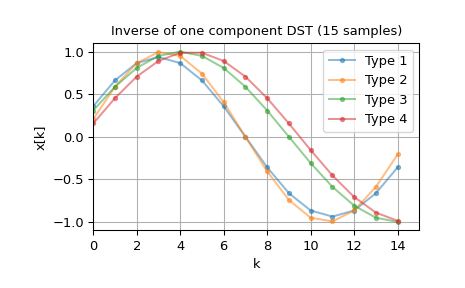
The resulting signals are sines with their period and their phase determined by the used DST type. The following table shows those, with N being the number of signal samples and n is the index of the non-zero bin (here:
N, n = 15, 1):Type
period in samples
phase shift in samples
1
\(2 (N+1) / (n+1) = 16\)
\(-1\)
2
\(2 N / (n+1) = 15\)
\(-1/2\)
3
\(2 N / (n+1/2) = 20\)
\(-1\)
4
\(2 N / (n+1/2) = 20\)
\(-1/2\)