scipy.special.
lqn#
- scipy.special.lqn(n, z)[source]#
Legendre functions of the second kind.
Compute sequence of Legendre functions of the second kind,
Qn(z)and derivatives for all degrees from 0 to n (inclusive). Returns two arrays of size(n+1,) + z.shapecontainingQn(z)andQn'(z).- Parameters:
- nint
Maximum degree of the Legendre functions.
- zarray_like, complex
Real or complex input values.
- Returns:
- Qn_zndarray, shape (n+1,) + shape(z)
Values for all degrees
0..n- Qn_d_zndarray, shape (n+1,) + shape(z)
Derivatives for all degrees
0..n
References
[1]Zhang, Shanjie and Jin, Jianming. “Computation of Special Functions”, John Wiley and Sons, 1996. https://people.sc.fsu.edu/~jburkardt/f77_src/special_functions/special_functions.html
Examples
Compute \(Q_n(x)\) and its derivatives on an interval.
>>> import numpy as np
>>> from scipy.special import lqn
>>> import matplotlib.pyplot as plt
>>> xs = np.linspace(-2, 2, 200)
>>> n_max = 3
>>> Qn, dQn = lqn(n_max, xs)
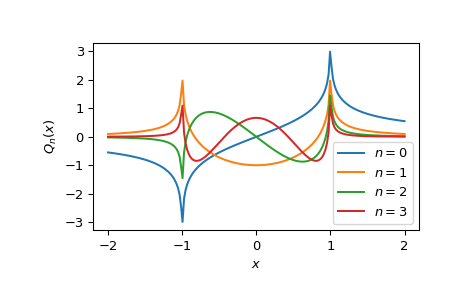
Plot the Legendre functions of the second kind \(Q_n(x)\).
>>> fig, ax = plt.subplots()
>>> ax.plot(xs, Qn.T, "-")
>>> ax.set_xlabel(r"$x$")
>>> ax.set_ylabel(r"$Q_n(x)$")
>>> ax.legend([fr"$n={n}$" for n in range(n_max + 1)])
>>> plt.show()
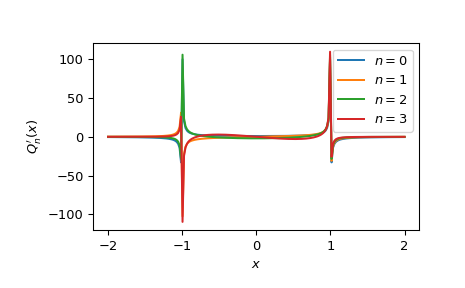
Plot the derivatives \(Q_n'(x)\).
>>> fig, ax = plt.subplots()
>>> ax.plot(xs, dQn.T, "-")
>>> ax.set_xlabel(r"$x$")
>>> ax.set_ylabel(r"$Q_n'(x)$")
>>> ax.legend([fr"$n={n}$" for n in range(n_max + 1)])
>>> plt.show()